





The world of Geometry Dash contains some of gaming’s most brutally challenging content, levels so difficult they require thousands of attempts and hundreds of hours to complete. This comprehensive guide explores what makes a level truly hard, examines the legendary Extreme Demons that define the game’s upper limits, and explains the community-driven systems that rank these impossible challenges.
Whether you’re curious about why certain levels are considered impossible or aspiring to conquer your first Demon difficulty, understanding the factors that create genuine challenge in this rhythm-based platformer provides insight into one of gaming’s most dedicated competitive communities.
What Makes a Geometry Dash Level Truly Hard?
Before exploring legendary levels, understanding the mechanics that create difficulty is essential. The gap between an Easy level and an Extreme Demon isn’t just more obstacles—it’s a fundamental transformation in what the game demands from players.
The Four Pillars of Difficulty
Tight Timing Windows
Extreme levels require inputs within frame-perfect windows, often less than 1/60th of a second. Miss the timing by a single frame, and you die instantly. These precision jumps eliminate the margin for error that makes easier levels forgiving. Where beginners can be “approximately correct” with timing, extreme content demands absolute precision synchronized with beat cues in the soundtrack.
High Speed and Gravity Manipulation
Speed portals multiply the auto-scrolling velocity, reducing reaction time to near zero. Combined with gravity portals that flip orientation mid-flight, players must rely entirely on muscle memory rather than visual reaction. The Ship, Wave, and UFO modes become especially challenging at extreme speeds where even slight input errors cascade into failure.
Complex Spam and Click Patterns
Many hard sections demand rapid, precise clicking patterns—sometimes exceeding 10-15 clicks per second sustained over extended periods. These “spam sections” test finger stamina and consistency. Players develop specific clicking techniques (single finger, alternating fingers, mouse vs keyboard) to handle these physically demanding segments.
Memory-Based Routes and Blind Jumps
The hardest levels incorporate invisible portals, fake paths, and completely blind jumps where obstacles aren’t visible until it’s too late to react. Players must memorize the entire level through repeated failures, building mental maps of every hidden danger. This transforms gameplay from reactive skill into memory execution.
The Compound Effect
A level becomes truly hard when combining all four factors across minutes of gameplay. An Extreme Demon might feature frame-perfect Wave mode at 4x speed through invisible corridors while simultaneously demanding 12-click-per-second spam—all without a single mistake across a 90-second duration. This compound difficulty separates challenging content from legendary trials.
Understanding the Official Difficulty System
RobTop Games implemented a star rating system (1-10 stars) that provides initial difficulty assessment, though the community has expanded this system significantly for precision at higher difficulties.
Star Ratings Explained
1-3 Stars (Easy/Normal): Entry-level content teaching basic jump timing, simple Ship mode control, and fundamental rhythm gameplay. These levels introduce mechanics like Jump Pads, Jump Orbs, and basic portal transitions.
4-6 Stars (Hard/Harder): Intermediate challenges requiring developed muscle memory, consistent execution of triple spike jumps, and comfortable control of Cube, Ship, and Ball modes. Spike avoidance becomes more demanding with tighter spacing.
7-9 Stars (Harder/Insane): Advanced content demanding mastery of Wave mode, Robot, and Spider forms. Timing windows tighten considerably, and levels feature complex mode transitions and speed variations requiring extensive Practice Mode usage.
10 Stars (Demon): The ultimate official tier, reserved for the hardest community-rated levels. However, the Demon category spans an enormous difficulty range—from levels slightly harder than Insane to content requiring months of dedicated practice.
The Demon tier’s vast range necessitated community-created sub-categories for meaningful difficulty assessment.
The Demon Difficulty Tiers
The Geometry Dash community established five Demon sub-categories, each representing exponential difficulty increases. This system, maintained by the Geometry Dash Demon List website, provides structure to the chaos of extreme difficulty.
Easy Demon
Skill requirement: Solid fundamentals with good consistency over 60-90 second levels.
Representative levels:
- The Lightning Road – Classic Easy Demon teaching extended Ship and Wave control
- Clubstep – Official RobTop level featuring early Spider mode usage
- Decode – Community favourite with clear visual design
Easy Demons represent the entry point to “serious” Geometry Dash. They demand skills beyond Insane difficulty but remain achievable for dedicated intermediate players willing to invest 500-2000 attempts.
Medium Demon
Skill requirement: Advanced mechanics mastery with high consistency over longer, more complex levels.
Representative levels:
- B (by Motley) – Tests sustained concentration
- Sakupen Egg – Demands precise Wave mode control
- Nine Circles – Popularized the intense Wave spam style
Medium Demons introduce extended difficult sections without respite. Players cannot rely on easy segments to recover focus—consistency must span the entire level.
Hard Demon
Skill requirement: Expert-level play with very tight timing windows and complex sight-reading.
Representative levels:
- Nine Circles – Often rated Hard Demon for its unforgiving Wave spam
- Future Funk – Complex Ship and Wave mode combinations
- Fairydust – Memory-heavy with precise timing requirements
Hard Demons push skilled players to their limits with frame-perfect sections, limited visual cues, and unforgiving obstacle density.
Insane Demon
Skill requirement: Elite territory requiring extreme concentration, extensive memory work, and serious time dedication.
Representative levels:
- Bloodbath – Historical benchmark that defined Insane difficulty
- Retention – Demanding memory level with tight corridors
- Hypersonic – Extremely fast gameplay testing reaction limits
Insane Demons require dedicated training schedules, specific practice regimens, and often 10,000-50,000 total attempts across weeks or months of practice.
Extreme Demon
Skill requirement: World-class play. These levels are conquerable only by the game’s absolute best players after hundreds of hours of focused practice.
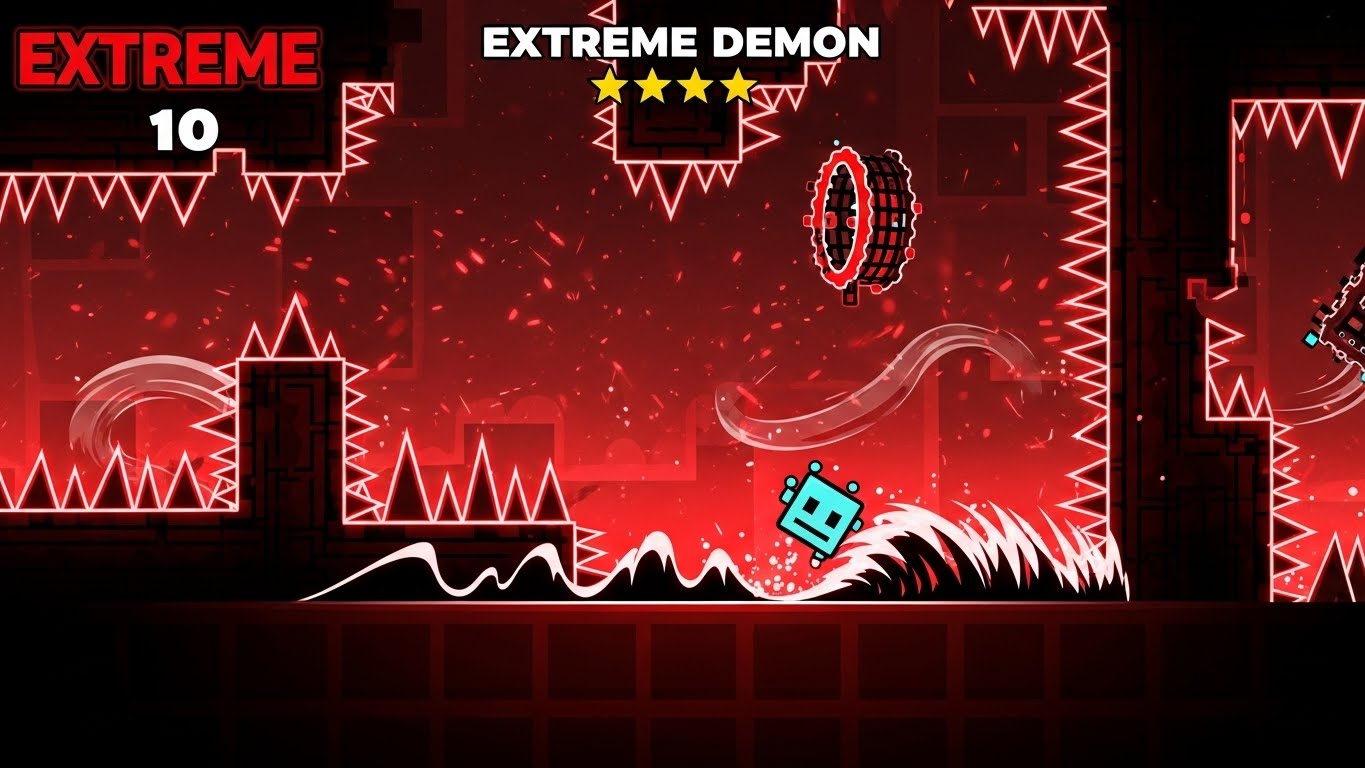
Extreme Demons represent the pinnacle of Geometry Dash difficulty—the primary focus of this guide and the content that defines the competitive upper echelon.
The Current Hardest Levels: Top Extreme Demons
The title of “hardest Geometry Dash level” constantly shifts as the Geometry Dash Demon List updates rankings based on new completions and community consensus. However, several levels consistently occupy the top positions.
Acheron
Creator: Ryamu (verified by Zoink) Position: Frequently ranks #1 or top 3 Length: Approximately 2 minutes
What makes it extreme:
Acheron combines incredible length with sustained difficulty across its entire duration. The level features brutally precise Ship and Wave sections at high speed, memory-based routes through nearly invisible obstacle fields, and frame-perfect timing requirements in multiple sections.
Key challenges:
- Extended Wave spam sections requiring 10+ seconds of perfect inputs
- Memory-heavy Ship corridors with invisible obstacles
- Minimal recovery points—mistakes at 90% feel as devastating as early deaths
- Verification required over 130,000 attempts from Zoink
The level’s length amplifies difficulty—maintaining perfect execution across two minutes of extreme challenges tests both skill and mental endurance.
Slaughterhouse
Creator: Icedcave (verified by Icedcave) Position: Consistently top 5, often #2 Length: Approximately 1 minute 45 seconds
What makes it extreme:
Slaughterhouse established new standards for Wave difficulty upon release. Its overwhelming red aesthetic creates visual intensity while near-frame-perfect Wave corridors demand absolute precision. The level popularized extremely tight Wave spam that influenced subsequent extreme level design.
Key challenges:
- Multiple 8-12 second Wave spam sections with minimal margin
- Speed changes mid-Wave requiring instant adaptation
- Visual density that can overwhelm even with extensive memorization
- Physical stamina demands from sustained clicking intensity
Many players consider Slaughterhouse’s Wave sections the hardest individual segments in any level.
Tidal Wave
Creator: OniLink (verified by Zoink) Position: Often top 3 Length: Approximately 1 minute 50 seconds
What makes it extreme:
Tidal Wave combines stunning visual design with impossible gameplay. The level features high-speed sections with extreme precision requirements, particularly in Ship and UFO modes. Its verification took Zoink over 150,000 attempts.
Key challenges:
- Frame-perfect UFO spam sections
- High-speed Ship corridors with minimal visual guidance
- Transitions between modes at critical moments
- Sustained difficulty without easy segments for mental recovery
The level proves extreme difficulty and beautiful design aren’t mutually exclusive.
Abyss of Darkness
Creator: Exen (verified by Exen) Position: Top 10 placement Length: Extended duration
What makes it extreme:
This level emphasizes memory and consistency over raw mechanical difficulty. Players must memorize extensive invisible sections while maintaining perfect rhythm gameplay throughout. The darkness theme limits visual information, forcing reliance on audio beat cues and memorization.
Historical Demons That Shaped Difficulty
Understanding current extreme difficulty requires examining the legendary levels that pioneered mechanics and established benchmarks throughout Geometry Dash history.
Bloodbath
Creator: Riot (decorated and verified by Riot) Historical significance: First recognized “hardest level” that established Insane Demon category
Legacy: Bloodbath represented a quantum leap in difficulty when verified in 2015. It popularized extended Wave spam sections and demonstrated that levels could demand thousands of attempts while remaining (barely) possible. The level became a rite of passage—completing Bloodbath marked entry into elite player status.
The verification process required over 30,000 attempts, shocking the community and establishing that extreme difficulty was achievable through dedication.
Tartarus
Creator: Riot and collaborators Historical significance: Held #1 hardest position for extended period
Legacy: Tartarus pushed difficulty through sheer length and sustained challenge density. The level features extended sections where single mistakes at 80%+ completion waste minutes of perfect play. It tested player psychology as much as mechanical skill—maintaining focus through repeated failures near the end required mental fortitude beyond previous levels.
Tartarus established that the hardest levels would test stamina and consistency over extended durations.
The Golden
Creator: zylenox (verified by zylenox) Historical significance: Pioneered memory-heavy extreme difficulty
Legacy: The Golden proved extreme difficulty could come from memorization rather than pure mechanical execution. The level features extensive fake routes, invisible portals, and paths that look correct but lead to death. Players must memorize every section through trial and error, building mental maps through hundreds of failures.
This memory-focused approach influenced numerous subsequent extreme levels, establishing memorization as a valid difficulty vector.
The Impossible Level Phenomenon
Some creators design levels never intended for completion—”Impossible Levels” that push beyond even Extreme Demon difficulty into theoretical territory.
True Impossible Levels
These levels contain sections requiring inputs shorter than one frame (1/60th second) or feature mathematically impossible obstacle configurations. No human player can complete them without game modifications.
Examples:
- Frame-perfect spam exceeding 60 clicks per second sustained
- Obstacles spaced closer than character hitbox allows
- Timing windows requiring sub-frame precision
True Impossible levels serve as technical demonstrations of the game engine’s limits rather than playable content.
Near-Impossible Levels
These levels are technically possible but demand consistency so absurd they may remain unverified for years. They require perfect execution of frame-perfect inputs 20-30+ times consecutively—statistically improbable even for world-class players.
Some near-impossible levels eventually receive verification after years of attempts by dedicated players, often sparking debate about whether they should be added to the Demon List.
The Geometry Dash Demon List System
The Geometry Dash Demon List (commonly called “the Demon List”) is a community-maintained website ranking the hardest levels. Understanding this system provides context for difficulty discussions.
How Levels Get Ranked
Verification Process:
- Creator builds level and submits to list moderators
- Verification player beats the level, recording full completion
- Moderators review footage for legitimacy
- List team discusses placement based on comparisons to existing levels
- Level receives initial ranking, subject to adjustment
Ranking Adjustments:
Rankings change based on community consensus. When many top players complete a level faster than expected, it may be moved down the list. Conversely, levels that few can beat despite extended attempts move upward.
This dynamic system ensures rankings reflect current skill levels rather than historical assessments.
Player Points System
Players earn points for completing listed Demons:
- Top 10 levels: Maximum points
- #11-50: High points
- #51-150: Moderate points
- Beyond #150: Minimal points
This system tracks player progression and creates competitive leaderboards showing who’s completed the most difficult content.
Training for Extreme Difficulty
Aspiring to complete Hard, Insane, or Extreme Demons requires structured practice beyond simply attempting levels repeatedly.
Start Position Practice
The Practice Mode “Start Position” feature allows practicing from any point in a level. Effective training involves:
Practice the ending first: The final 10-20% of levels often feature the hardest sections. Master the ending in isolation before attempting full runs. This ensures that when you reach the end after minutes of perfect play, you can actually finish.
Identify choke points: Find the 2-3 sections causing 80% of deaths. Practice only those sections for entire practice sessions, drilling them 50-100 times until execution becomes automatic.
Build consistency: Practice each section until you can pass it 10 consecutive times without mistakes. This consistency threshold indicates muscle memory has developed.
Mental Stamina Development
Extreme Demons test psychology as much as mechanics:
Session management: Practice in focused 30-45 minute sessions with breaks. Mental fatigue dramatically increases errors.
Failure reframing: Every death provides learning. Instead of frustration, analyze what went wrong and adjust.
Visualization practice: Between sessions, mentally visualize successful completion. This cognitive rehearsal strengthens muscle memory pathways.
Progress celebration: Reaching new best percentages (75%, 85%, 95%) represents genuine achievement worth acknowledging.
Physical Conditioning
Extended extreme level attempts demand physical preparation:
Hand stretching: Stretch fingers and wrists before sessions and during breaks Posture awareness: Maintain proper posture to prevent fatigue Click technique optimization: Experiment with single finger, alternating fingers, or mouse clicking to find your optimal method Stamina building: Practice clicking consistency—sustained 8-10 clicks per second for 30+ seconds
Creating Extreme Demons: The Designer’s Perspective
Designing top-tier difficulty requires as much skill as beating it. Understanding the creative process provides appreciation for these digital torture chambers.
Sync and Flow
Rhythm synchronization: Every obstacle, speed change, and portal aligns with beat cues in the soundtrack. Creators spend hours ensuring jumps land on drum beats or melody accents.
Difficulty flow: Well-designed levels build and release tension. Extreme difficulty punctuated by brief recovery sections prevents player burnout while maintaining challenge.
Fair but brutal: The best Extreme Demons feel challenging but fair—difficult because they demand perfection, not because they’re random or unclear.
The Verification Challenge
Creators must verify their own levels before upload, proving completion is possible. This verification process becomes its own endurance test.
Verification statistics:
- Acheron: 130,000+ attempts by Zoink
- Slaughterhouse: 100,000+ attempts by Icedcave
- Tidal Wave: 150,000+ attempts by Zoink
These verification attempt counts exceed most players’ lifetime totals across all levels, demonstrating the dedication required from creators.
Decoration and Performance
Modern Extreme Demons feature detailed visual design—custom backgrounds, particle effects, and colour schemes. However, decoration must balance with performance. Overly decorated levels cause lag, introducing artificial difficulty through technical problems rather than intentional design.
The best creators optimize decoration for visual impact while maintaining smooth 60 FPS gameplay critical for frame-perfect execution.
The Community and Competition
The Extreme Demon community creates culture beyond simple level completion, fostering competition, collaboration, and content creation.
Streaming and Content Creation
Top players stream attempts on YouTube and Twitch, building audiences who watch thousands of deaths leading to eventual victory. These streams showcase the dedication required while providing entertainment and educational value.
Completion videos often receive hundreds of thousands of views, making elite players recognizable within the community.
Collaboration and Support
Despite competition, the community maintains supportive culture:
- Players share strategies and route optimizations
- Discord servers provide encouragement during grinding
- Completion messages receive community celebration
- New players receive guidance from veterans
This positive atmosphere sustains players through the thousands of failures required for success.
Competitive Challenges
Beyond the Demon List rankings, players create additional challenges:
- Speed competitions: Fastest completion time
- Live verification: Completing new levels with live audience
- Challenge modes: Completing levels with self-imposed restrictions
- Consistency tests: Multiple completions proving reproducibility
These additional competitive layers maintain engagement beyond single completion.
Frequently Asked Questions
What’s currently the hardest level in Geometry Dash?
Rankings fluctuate, but Acheron, Slaughterhouse, and Tidal Wave consistently occupy top positions on the Geometry Dash Demon List. The exact #1 changes based on new completions and community consensus.
How many attempts do Extreme Demons require?
Top players typically require 50,000-150,000+ attempts for their first Extreme Demon completion, spread across weeks or months of dedicated practice.
Can mobile players complete Extreme Demons?
Yes, though most elite players use PC for lower input delay. Some Extreme Demons have mobile completions, demonstrating it’s possible despite technical disadvantages.
What’s the skill progression to reach Extreme Demons?
Most players follow this path: Master Insane official levels → Easy Demons → Medium Demons → Hard Demons → Insane Demons → Extreme Demons. This progression typically requires 1-3+ years of dedicated play.
Do Extreme Demon creators earn anything?
Creators earn recognition and Creator Points in-game, but no monetary compensation unless separately monetizing through YouTube or sponsorships.
Conclusion
The hardest levels in Geometry Dash represent the pinnacle of rhythm-based platformer challenge—digital trials demanding thousands of attempts, hundreds of hours, and unwavering dedication. From Bloodbath’s historical legacy to Acheron’s current dominance, these Extreme Demons push human limits of precision jumps, muscle memory, and mental endurance.
The Geometry Dash Demon List system provides structure to this chaotic difficulty landscape, creating competitive framework where elite players test themselves against progressively impossible challenges. Behind each extreme level lies a creator who spent months verifying their torture chamber, proving completion is theoretically possible before subjecting the community to the challenge.
Whether you’re curious about what makes content “impossible,” training for your first Demon, or simply appreciating the dedication of elite players, understanding these extreme challenges provides insight into one of gaming’s most passionate communities. Every completion represents triumph over digital adversity—proof that persistence, practice, and strategy can overcome obstacles that initially seem beyond human capability.
The journey from Easy levels to Extreme Demons is long, but every frame-perfect input, every memorized section, and every hard-earned completion moves players closer to joining the elite ranks. Keep practicing, keep grinding, and remember—every death is data for your next attempt.