

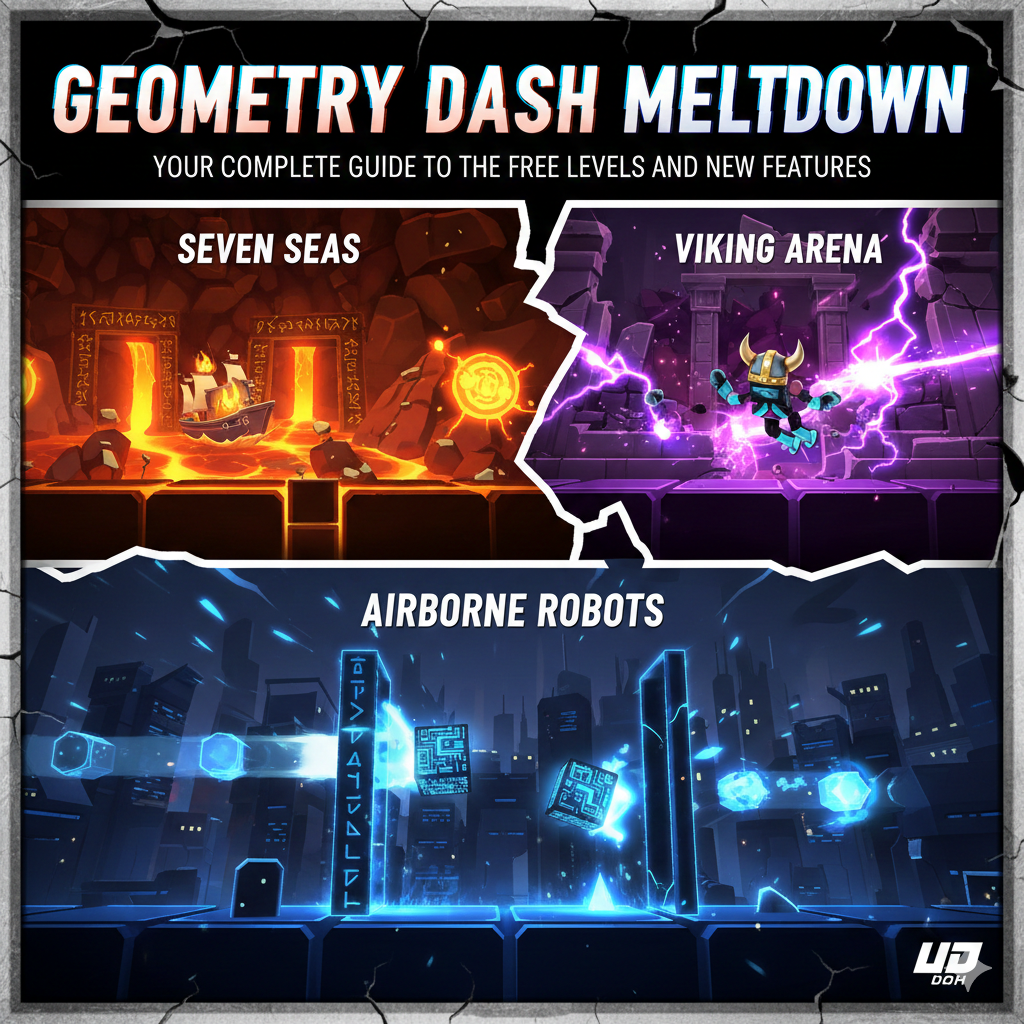
Geometry Dash Meltdown is a standalone, free-to-play spin-off of the popular rhythm-based platformer, Geometry Dash. Created by RobTop Games (developer Robert Topala), this explosive version serves as both an introduction to new players and a challenging experience for veterans seeking fresh content without spending money.
Released as a companion to the main series, Meltdown maintains the addictive tap to jump gameplay while introducing exclusive levels, unique customisation options, and mechanics that would later appear in major Geometry Dash updates. The game features intense rhythm gameplay synchronized perfectly to high-energy electronic music by F-777, creating an immersive experience where every obstacle aligns with beat cues in the soundtrack.
Think of GD Meltdown as a thrilling appetiser to the main Geometry Dash feast—completely free, packed with exclusive content, and designed to test your precision jumps and spike avoidance skills across three brutally challenging levels.
What Makes Geometry Dash Meltdown Different?
Standalone Free Experience
Unlike Geometry Dash Lite (which offers a limited demo of the main game), Geometry Dash Meltdown is a completely separate game with its own exclusive content. Players don’t need to own the main Geometry Dash Full Version to enjoy everything Meltdown offers.
Key differences from the main game:
- Only three levels (but extremely challenging)
- Exclusive level themes and visual styles
- Unique unlockable customisation items
- All content free with advertisements
- No Level Editor or Community Levels access
- Practice Mode with practice checkpoints included
- Smaller file size for mobile devices
The F-777 Soundtrack Experience
All three Meltdown levels feature exclusive music tracks by electronic artist F-777, known for creating high-energy compositions perfect for rhythm-based platformers. The soundtrack includes:
- The Seven Seas – “At the Speed of Light” by F-777
- Viking Arena – “Monsters” by F-777
- Airborne Robots – “Airborne Robots” by F-777
These tracks weren’t available in the main Geometry Dash game at Meltdown’s release, making this spin-off special for fans of F-777’s distinctive electronic style. The music drives the gameplay, with every obstacle and Jump Pad perfectly synchronized to drum beats and melody drops.
Visual Theme and Atmosphere
Geometry Dash Meltdown embraces a darker, more intense visual aesthetic compared to the colourful main game. The levels feature:
- Fire and lava-themed environments
- Industrial and futuristic settings
- Darker colour palettes with dramatic lighting
- Battle-ready, aggressive design elements
- Explosive visual effects and particle systems
This thematic consistency creates a cohesive experience distinct from other Geometry Dash titles.
The Three Epic Levels in Geometry Dash Meltdown
Complete Level Overview
| Level Name | Difficulty | Music Artist | Stars | Secret Coins | Key Features |
| The Seven Seas | Hard (6 stars) | F-777 | 6 | 3 | Fire/magma theme, Ship mode focus, underwater sections |
| Viking Arena | Harder (7 stars) | F-777 | 7 | 3 | Stone/thunder theme, intense speed changes, Ball mode challenges |
| Airborne Robots | Insane (8 stars) | F-777 | 8 | 3 | Futuristic theme, Robot mode introduction, dual portal segments |
Each level includes three secret Coins hidden throughout, requiring exploration and often more difficult routes to collect. These Coins unlock exclusive customisation items available only in GD Meltdown.
Progression and Difficulty Curve
The three levels follow a steep difficulty progression:
The Seven Seas serves as the entry point, rated Hard difficulty. While challenging for beginners, it’s manageable for players who’ve completed a few main Geometry Dash levels. The level teaches fundamental rhythm gameplay and Ship mode control.
Viking Arena significantly increases difficulty with faster auto-scrolling speed, tighter timing windows for precision jumps, and complex Ball mode segments requiring quick gravity flips. Many players spend considerable time mastering this Harder difficulty level.
Airborne Robots represents the ultimate challenge in GD Meltdown, rated Insane difficulty. This level introduces the Robot mode, features dual portal segments where players control two characters simultaneously, and demands mastery of all previous skills. Completion requires extensive Practice Mode usage and muscle memory development.
Level 1: The Seven Seas – Complete Strategy Guide
Level Overview and Theme
The Seven Seas plunges players into a lava-filled, oceanic environment with fire effects and dramatic visual elements. This Hard difficulty level (6 stars) runs approximately 1 minute 30 seconds and features multiple mode transitions including Cube, Ship, and Ball segments.
Difficulty rating: Hard (6 stars) Length: 1:30 approximate Primary challenges: Ship mode control, gravity flip timing, underwater obstacle navigation
Section-by-Section Breakdown
Opening Cube Section (0-15 seconds): The level begins with straightforward Cube gameplay at moderate speed. Focus on basic jump timing synchronized with the music’s drum beats. Several triple spike formations require quick tap-tap-tap rhythms. This section builds confidence before the difficulty increases.
First Ship Segment (15-35 seconds): Upon entering the blue portal, Ship mode activates. This segment tests smooth altitude control through tight vertical corridors. The key is avoiding jerky inputs—use gentle holds and releases rather than frantic tapping. Watch for gravity portals that flip your flight direction, indicated by small arrows on screen.
Underwater Ball Section (35-55 seconds): The orange portal transforms you into Ball mode. This underwater-themed segment features spikes on both floor and ceiling, requiring precise gravity flip timing. Tap to jump from floor to ceiling, then tap again to return. The rhythm matches the song’s beat pattern—listen carefully to beat cues for timing guidance.
Speed Corridor (55-1:10): Speed increases significantly through this Cube section. Triple spike jumps come rapidly, demanding quick reactions and muscle memory. The visual busyness can overwhelm—focus on listening to the music rhythm rather than purely visual reaction.
Final Ship Challenge (1:10-1:30): The concluding Ship segment features the tightest corridors in the level. Small mistakes crash you into spikes instantly. Practice this section extensively in Practice Mode, placing practice checkpoints before difficult parts. Smooth, minimal inputs work better than overreacting to each obstacle.
Secret Coins Location
Coin 1 (at 25 seconds): During the first Ship segment, fly to the very top of the screen where a coin floats above the normal path. Requires precise upward flight.
Coin 2 (at 48 seconds): In Ball mode, jump to the ceiling earlier than normal to collect a coin on an alternate ceiling path. More difficult than the main route.
Coin 3 (at 1:15): During the final Ship section, briefly fly lower than usual to grab a coin below the standard path. Tight timing with obstacles immediately after.
Tips for Mastery
Use Practice Mode extensively: Place checkpoints every 10-15 seconds to isolate difficult segments. The final Ship section alone may require 100+ practice attempts.
Listen to the soundtrack: “At the Speed of Light” by F-777 contains clear beat cues indicating when to jump or flip gravity. The drum beats align perfectly with triple spike timings.
Master Ship control: This level emphasises Ship mode more than later levels. Developing smooth flight control here prepares you for harder content.
Expect 200-500 attempts: Most players require several hundred attempts for first completion. Every death teaches obstacle patterns and timing.
Level 2: Viking Arena – Advanced Strategies
Level Overview and Theme
Viking Arena embraces a stone and thunder aesthetic with Norse-inspired visual elements. This Harder difficulty level (7 stars) features significantly faster auto-scrolling speed and more complex obstacle patterns than The Seven Seas.
Difficulty rating: Harder (7 stars) Length: 1:35 approximate Primary challenges: Rapid Ball mode gravity flips, triple spike jumps, speed variations, tight timing windows
Section-by-Section Breakdown
Opening Speed Gauntlet (0-20 seconds): Viking Arena immediately establishes its difficulty with fast Cube gameplay. Triple and quadruple spike formations appear rapidly, requiring precise jump timing synchronized with F-777’s “Monsters” track. The rhythm follows eighth notes—quick, consistent taps work better than hesitant inputs.
Ball Mode Introduction (20-45 seconds): The orange portal activates Ball mode earlier than expected, catching unprepared players. This segment demands rapid gravity flipping through spike-filled tunnels. Tap on every beat of the music—the rhythm matches gravity flip requirements almost perfectly. Missing even one flip usually means death.
Mini Cube Section (45-55 seconds): A brief respite in mini Cube mode (smaller character size) allows minimal recovery time. However, the smaller size makes spike avoidance more precise—gaps that seemed comfortable become tight squeezes.
Dual Ball Segment (55-1:15): The most challenging section features extended Ball mode at high speed. Spikes appear on both floor and ceiling in rapid succession, requiring split-second decisions on gravity flipping. This segment alone may require hours of Practice Mode work to develop the necessary muscle memory.
Wave Mode Introduction (1:15-1:25): Viking Arena briefly introduces Wave mode (pink portal), where holding moves you upward diagonally and releasing moves you downward. Even this short segment challenges players unfamiliar with Wave controls. Focus on smooth, gradual holds and releases rather than on/off tapping.
Final Cube Rush (1:25-1:35): The conclusion combines everything learned: triple spikes, Jump Pads, Jump Orbs, and speed changes. Listen to the music’s final buildup—it telegraphs the obstacle pattern perfectly.
Secret Coins Location
Coin 1 (at 30 seconds): During early Ball mode, flip to the ceiling path where a coin floats. Slightly more difficult route with additional ceiling spikes.
Coin 2 (at 1:05): In the intense Ball segment, briefly drop to a lower floor path to collect a coin. Requires perfect timing to return to the main path immediately after.
Coin 3 (at 1:28): Near the level’s end, jump higher than normal over a Jump Pad to collect an overhead coin. Tight timing with obstacles immediately following.
Advanced Tips
Master Ball mode gravity flips: Viking Arena is fundamentally a Ball mode mastery test. Spend dedicated practice time in just the Ball segments until flipping becomes automatic.
Count the rhythm: The triple spike patterns follow predictable rhythmic intervals. Count “1-2-3” with the music beats to internalise timing.
Recognise pattern repetition: Several obstacle combinations repeat throughout the level. Once you’ve mastered a pattern in one location, you’ll recognise it elsewhere.
Expect 500-1000 attempts: Viking Arena typically requires significantly more attempts than The Seven Seas. The difficulty spike is substantial.
Watch completion videos: Observing skilled players reveals optimal paths and timing that aren’t immediately obvious.
Level 3: Airborne Robots – Mastering the Ultimate Challenge
Level Overview and Theme
Airborne Robots delivers the peak challenge in Geometry Dash Meltdown with its Insane difficulty rating (8 stars). This futuristic, technology-themed level introduces the Robot mode and features the series’ signature dual portal segments where players control two characters simultaneously.
Difficulty rating: Insane (8 stars) Length: 1:40 approximate Primary challenges: Robot mode mastery, dual portal control, complex Wave segments, extreme speed sections
Understanding Robot Mode
Before attempting Airborne Robots seriously, understanding Robot mode mechanics is essential:
Robot mode characteristics:
- Activated by green portals
- Jumps higher than standard Cube mode
- Falls faster with more impact
- Hold for maximum jump height
- Tap for shorter, controlled hops
- Ideal for clearing tall obstacles
The Robot sections in Airborne Robots require precise control over jump height by varying hold duration. Short taps clear single spikes, while holds clear large gaps or tall obstacles.
Section-by-Section Breakdown
Technical Cube Opening (0-15 seconds): Airborne Robots begins with deceptively simple Cube gameplay, lulling players into false confidence. The obstacles are straightforward, but the real challenge comes immediately after.
First Robot Segment (15-35 seconds): The green portal introduces Robot mode. This section teaches height control through varied obstacle heights—some require full jumps (hold), others require minimal hops (tap). The rhythm alternates between holds and taps, matching the song’s melody patterns. Most players die repeatedly here while learning Robot physics.
Speed Corridor with Jump Orbs (35-50 seconds): Speed increases through a Cube section featuring multiple Jump Orbs (yellow and pink orbs requiring tap input while touching). Missing even one orb input usually results in death. The pink orbs provide higher jumps than yellow—memorise which colour appears where.
Dual Portal Section (50-1:10): The most notorious segment in all of GD Meltdown. A dual portal splits your character into two—one on the floor, one on the ceiling. Every input affects both simultaneously. This segment demands intense concentration and extensive Practice Mode drilling.
Dual portal survival tips:
- Focus primarily on the top character—let the bottom follow
- The mirrored movement means both face the same obstacles
- Rhythm remains consistent—tap on beats like normal
- Place multiple practice checkpoints through this section
- Expect this single segment to require hundreds of isolated practice attempts
Wave Mode Challenge (1:10-1:25): After surviving dual portals, Wave mode tests smooth control through diagonal corridors. Hold to rise, release to fall—smooth pressure changes work better than rapid on/off inputs. The corridor forces constant adjustment without time to recover from mistakes.
Final Robot/Cube Combination (1:25-1:40): The conclusion combines Robot sections with Cube gameplay in rapid alternation. Portal transitions happen quickly, requiring immediate adaptation to different physics. The final stretch features multiple Jump Pads launching you through the level’s conclusion.
Secret Coins Location
Coin 1 (at 28 seconds): During the first Robot segment, jump higher than necessary to reach an overhead path containing a coin. Requires precise jump height control.
Coin 2 (at 1:02): Within the dual portal nightmare section, both characters must navigate to an alternate path containing a coin. Significantly harder than the normal route—most players collect this last.
Coin 3 (at 1:32): Near the level’s conclusion, a coin floats below the main path during a Robot section. Drop down briefly to collect it, then immediately jump to rejoin the normal route.
Expert-Level Tips
Isolate the dual portal section: Place practice checkpoints immediately before and after this segment. Spend dedicated sessions (30+ minutes) drilling only this part until the mirrored control becomes intuitive.
Master Robot jump heights: Create personal checkpoints in Practice Mode that test only Robot segments. Experiment with different hold durations to learn precise height control.
Use audio cues religiously: F-777’s “Airborne Robots” track contains clear melody cues for every major obstacle. The electronic drops signal portal transitions and difficulty spikes.
Expect 1000-2000+ attempts: Airborne Robots challenges even experienced Geometry Dash players. Many players report 2000-5000 attempts for first completion. This is normal—the level is intentionally brutal.
Take breaks frequently: Mental fatigue significantly impacts performance. Practice in 20-30 minute sessions with breaks between.
Celebrate progress milestones: Reaching 50%, 75%, or 90% completion is genuine achievement. Each percentage represents mastery of additional segments.
Exclusive Meltdown Customisation and Unlockables
Unique Character Designs
Geometry Dash Meltdown offers exclusive customisation items unavailable in other Geometry Dash versions at the time of release. These battle-ready, aggressive designs match the game’s intense aesthetic.
Unlockable content includes:
Cube designs:
- Fire-themed cubes with flame effects
- Industrial, mechanical cube styles
- Dark, aggressive designs matching level themes
- Exclusive patterns not found in main game
Ship designs:
- Rocket-style ships with flame trails
- Futuristic spacecraft designs
- Angular, aggressive ship profiles
- Exclusive Ship mode appearances
Ball designs:
- Spiked ball variations
- Mechanical ball designs
- Battle-themed rolling forms
- Unique textures and effects
UFO designs:
- Industrial UFO styles
- Battle-ready UFO appearances
- Exclusive UFO mode options
Robot designs:
- Mechanical Robot appearances
- Industrial Robot themes
- Battle-focused designs
Wave designs:
- Aggressive Wave patterns
- Unique trail effects
- Exclusive Wave mode appearances
Colour Schemes and Effects
Beyond character designs, GD Meltdown unlocks exclusive:
Primary and secondary colours:
- Dark, intense colour options
- Fire-themed reds and oranges
- Industrial greys and blacks
- Exclusive colour combinations
Death effects:
- Explosive death animations
- Fire-based destruction effects
- Unique particle systems
- Battle-themed explosions
Trails:
- Flame trail effects
- Industrial particle trails
- Aggressive visual following effects
Unlocking System
How to unlock customisation:
Complete levels: Finishing The Seven Seas, Viking Arena, and Airborne Robots in Normal Mode (not Practice Mode) unlocks specific items.
Collect secret Coins: Each of the nine total Coins (three per level) unlocks exclusive customisation options. Collecting all Coins provides the complete Meltdown customisation set.
Earn Stars: Completing levels awards Stars based on difficulty (6, 7, and 8 Stars respectively). Stars contribute to overall progression and additional unlocks.
Open chests: Earned keys from gameplay allow opening treasure chests containing randomised customisation items.
Transferring Unlocks to Main Game
A major benefit: Meltdown customisation items transfer to the main Geometry Dash game if you own the Geometry Dash Full Version.
Transfer process:
- Complete levels and collect Coins in GD Meltdown
- Ensure you’re logged into the same account (if using cloud saves)
- Open main Geometry Dash game
- Meltdown-exclusive items appear in your customisation menu
- Use these exclusive designs in main game levels and Community Levels
This feature makes GD Meltdown valuable for main game players seeking rare, exclusive customisation options.
Controls and Gameplay Mechanics
Basic Control Scheme
Geometry Dash Meltdown uses identical controls to the main series:
Mobile game controls:
- Tap anywhere on screen to jump (Cube, Robot)
- Hold to fly upward, release to descend (Ship)
- Tap to flip gravity (Ball)
- Tap for vertical boosts (UFO)
- Hold to move upward diagonally, release to move downward (Wave)
Keyboard controls (if playing on PC emulator):
- Spacebar to jump/interact
- Up Arrow alternative input
- W key alternative input
- Mouse click alternative input
Game Mode Mechanics in Meltdown
Cube Mode (Default): Standard tap to jump platforming. The foundation of all Geometry Dash gameplay. Jump height and trajectory are fixed—timing is everything.
Ship Mode (Blue Portal): Hold to ascend, release to descend. Meltdown features extensive Ship segments, particularly in The Seven Seas. Smooth, gradual inputs prevent crashing into obstacles.
Ball Mode (Orange Portal): Tap to flip between floor and ceiling while rolling continuously. Viking Arena emphasises Ball mode heavily, requiring rapid gravity flip mastery.
Robot Mode (Green Portal): Introduced in Airborne Robots. Jump higher than Cube mode, with hold duration affecting jump height. Falls faster upon landing.
Wave Mode (Pink Portal): Brief appearances in Viking Arena and Airborne Robots. Hold for diagonal upward movement, release for diagonal downward movement. No landing—constant motion through corridors.
Jump Pads and Jump Orbs
Jump Pads (yellow and blue):
- Yellow pads: Automatic bounce on contact, standard height
- Blue pads: Automatic bounce on contact, higher trajectory
- No input required—simply land on them
Jump Orbs (yellow, pink, blue, green):
- Require tap input while touching to activate
- Yellow orbs: Standard upward boost
- Pink orbs: Higher upward boost
- Blue orbs: Gravity reversal
- Green orbs: Sideways momentum
Understanding the difference between automatic Jump Pads and input-required Jump Orbs prevents countless deaths.
Practice Mode Usage
Practice Mode remains essential for learning Meltdown levels:
How to use Practice Mode effectively:
- Tap the wrench button before starting any level
- Green practice checkpoints appear automatically as you progress
- Upon death, respawn at your most recent checkpoint
- Place checkpoints strategically before difficult sections
- Drill problem areas 20-50 times until muscle memory develops
- Gradually extend consistency zones by moving checkpoints forward
Important: Practice Mode progress doesn’t count toward completion. You must beat levels in Normal Mode to earn Stars, collect Coins officially, and unlock customisation items.
How to Download and Play Geometry Dash Meltdown
Mobile Download Instructions
For iOS devices (iPhone, iPad):
- Open the App Store
- Search “Geometry Dash Meltdown”
- Tap “Get” to download (free)
- Install and open the game
- Grant audio permissions for best experience
For Android devices:
- Open Google Play Store
- Search “Geometry Dash Meltdown”
- Tap “Install” (free download)
- Open after installation
- Enable audio for full rhythm gameplay experience
File size: Approximately 50-70 MB (significantly smaller than main game)
System Requirements
Minimum requirements:
- iOS 8.0 or later (iPhone, iPad, iPod touch)
- Android 4.0 or later
- 100 MB free storage space
- Audio capability (speakers or headphones)
Recommended for best experience:
- iOS 10.0+ or Android 6.0+
- Headphones for clear beat cues
- Stable device performance for 60 FPS gameplay
- “Do Not Disturb” mode to prevent interruptions
Playing with Audio
Critical importance of sound:
Geometry Dash Meltdown is fundamentally a rhythm-based platformer—playing without audio significantly increases difficulty. F-777’s soundtrack provides beat cues that telegraph obstacle timing.
Audio setup recommendations:
- Use quality headphones or earphones
- Adjust volume so music is clear but not overwhelming
- Ensure no audio lag or desynchronisation
- Turn off competing audio sources
- Enable device audio before launching game
Many players report 50%+ improvement in performance simply by playing with audio after previously attempting levels muted.
Why Play Geometry Dash Meltdown?
Perfect Introduction to the Series
For newcomers to Geometry Dash:
Low barrier to entry: Completely free with no upfront cost makes testing the series risk-free.
Manageable content volume: Three levels prevent overwhelming newcomers with too many choices.
Teaches core mechanics: Meltdown covers Cube, Ship, Ball, Robot, and Wave modes—all essential for the main game.
Difficulty progression: The Hard → Harder → Insane curve prepares players for main game difficulty ratings.
Practice Mode included: Full access to practice checkpoints allows systematic learning without frustration.
Transferable skills: Everything learned in Meltdown applies directly to the main Geometry Dash game.
Valuable Training for Main Game Players
For experienced Geometry Dash players:
Robot mode introduction: Meltdown introduces Robot mechanics before attempting main game levels featuring this mode.
Rhythm training: F-777’s tracks develop rhythm gameplay skills applicable to all Geometry Dash content.
Dual portal practice: The dual segment in Airborne Robots prepares players for similar mechanics in main game Demon levels.
Exclusive customisation: Unlocking Meltdown-exclusive items adds rare options to main game customisation menus.
Free challenge content: Three legitimately difficult levels at no cost extend gameplay variety.
Speed training: Meltdown levels feature faster auto-scrolling speeds than early main game levels, developing quick reaction skills.
Standalone Value
Even without playing other Geometry Dash games:
Complete experience: GD Meltdown offers beginning, middle, and end with three progressively challenging levels.
Exclusive content: These levels and customisation items exist only in Meltdown.
F-777 soundtrack: Music fans enjoy three full F-777 tracks integrated with gameplay.
Replayability: Coins collection, Stars earning, and time improvement provide replay value.
Mobile-optimised: Smaller file size and simpler content make it ideal for mobile devices with limited storage.
No internet required: Play offline after initial download (except for advertisements between attempts).
Common Challenges and Solutions
The Seven Seas Difficulties
Challenge: Ship mode control feels imprecise and jerky
Solution: Practice smooth, gradual holds and releases. Avoid frantic tapping—Ship mode rewards gentle altitude adjustments. Use Practice Mode to drill just the Ship segments until control becomes automatic.
Challenge: Underwater Ball section spikes on both surfaces
Solution: Listen to the music rhythm—gravity flips align perfectly with drum beats. Count “1-2-1-2” with the music while flipping. Focus on audio timing rather than visual reaction.
Challenge: Final Ship corridor too tight
Solution: This segment requires extensive Practice Mode work. Place checkpoints immediately before it and practice 50-100 times. Learn to anticipate corridor bends based on music cues.
Viking Arena Difficulties
Challenge: Triple spike jumps come too fast
Solution: These follow eighth-note rhythms in the music. Tap quickly on “1-and-2-and-3” counts. Develop muscle memory through repetition—your fingers will learn the rhythm faster than your conscious mind.
Challenge: Extended Ball mode section overwhelms
Solution: Break it into 5-second segments using practice checkpoints. Master each segment individually before attempting the full section. The pattern repeats—recognising repeated sequences helps.
Challenge: Speed changes disrupt timing
Solution: Pay attention to visual speed change indicators (speed portals). The music tempo changes mirror gameplay speed shifts—let audio guide your reaction timing.
Airborne Robots Difficulties
Challenge: Robot jump heights inconsistent
Solution: Practice Robot segments in isolation, experimenting with different hold durations. Short taps for small obstacles, medium holds for standard jumps, long holds for maximum height. Create “training checkpoints” testing only Robot mechanics.
Challenge: Dual portal section impossible to control
Solution: Focus on only the top character—completely ignore the bottom one. The mirrored movement means if the top character succeeds, the bottom automatically does too. This counter-intuitive approach dramatically simplifies the segment.
Challenge: Wave mode sections too sensitive
Solution: Wave mode responds to input pressure, not just on/off states. Practice extremely gradual holds and releases. Think “smooth curves” not “sharp angles.” Even slight overreaction causes crashes.
Challenge: Overall difficulty too high, causing frustration
Solution: Take mandatory breaks every 20-30 minutes. Mental fatigue exponentially increases mistakes. Return with fresh focus. Remember: 1000+ attempts is normal for Airborne Robots. Progress, not perfection.
Comparison with Other Free Geometry Dash Games
Geometry Dash Lite vs Meltdown
Geometry Dash Lite:
- 13 levels from main game (limited selection)
- Covers Easy through Hard difficulties
- Advertisement-supported
- No exclusive content
- Demo/trial version of main game
- No Robot or Spider modes
Geometry Dash Meltdown:
- 3 exclusive levels (not in main game)
- Hard, Harder, and Insane difficulties
- Advertisement-supported
- Exclusive customisation and Robot mode
- Standalone experience, not a demo
- Complete content for free
Verdict: Lite works as a trial for the main game. Meltdown offers unique content worth playing regardless of main game ownership.
Geometry Dash World vs Meltdown
Geometry Dash World:
- 10 exclusive levels
- Easy through Insane difficulties
- More content volume
- Wider difficulty range
- Multiple exclusive worlds/themes
- Introduction to more recent mechanics
Geometry Dash Meltdown:
- 3 exclusive levels
- Hard through Insane only
- More focused experience
- Steeper difficulty curve
- Unified theme (fire/technology)
- Earlier release, classic feel
Verdict: World provides more content variety. Meltdown offers a tighter, more challenging experience.
Geometry Dash SubZero vs Meltdown
Geometry Dash SubZero:
- 3 exclusive levels
- Hard through Insane difficulties
- Latest free spin-off (most modern)
- Contemporary mechanics
- Updated visual style
- More recent music selection
Geometry Dash Meltdown:
- 3 exclusive levels
- Hard through Insane difficulties
- Earlier release (classic status)
- Traditional Geometry Dash feel
- F-777 soundtrack throughout
- Established community favourite
Verdict: SubZero feels more modern. Meltdown maintains classic Geometry Dash charm with consistent F-777 soundtrack.
Advanced Tips and Techniques
Rhythm Training Methods
Develop superior rhythm gameplay skills:
Tap along before playing: Before attempting a level, play its music and tap along without gaming. This builds internal rhythm recognition.
Count beats verbally: While practising, count “1-2-3-4” or “1-and-2-and” aloud to internalise patterns.
Identify melody cues: F-777’s tracks contain distinct melody changes signalling major obstacles or portal transitions.
Create rhythm checkpoints: Place practice checkpoints at specific musical phrases to associate obstacles with soundtrack segments.
Practice with eyes closed: On fully memorised sections, attempt them with eyes closed, relying purely on audio beat cues and muscle memory.
Muscle Memory Development
Build automatic response patterns:
Repetition threshold: Most segments require 30-50 consecutive successful completions before muscle memory solidifies.
Spaced repetition: Practice a difficult section 50 times today, 30 times tomorrow, and 20 times two days later. This spacing reinforces memory more effectively than single marathon sessions.
Micro-sections: Break seemingly impossible segments into 2-3 second micro-sections. Master each individually, then connect them sequentially.
Visualisation practice: Between gaming sessions, mentally visualise completing difficult sections. This cognitive rehearsal strengthens muscle memory pathways.
Consistency over speed: During Practice Mode, prioritise completing sections consistently (10 times in a row) over completing them once quickly.
Pattern Recognition Skills
Learn to recognise and anticipate:
Obstacle families: Triple spikes, staircase jumps, Wave corridors—these patterns repeat across levels. Once mastered in one context, you’ll recognise them elsewhere.
Musical patterns: Repeating musical phrases often correspond to repeating obstacle patterns. When you hear a familiar melody section, anticipate familiar obstacles.
Visual triggers: Certain background elements or colour changes telegraph upcoming difficulty increases or mode transitions.
Portal sequences: The order of portals (blue → orange → green) creates recognisable gameplay flow patterns.
Rhythm cycles: Many sections follow 4-beat or 8-beat cycles that repeat. Identifying these cycles simplifies memorisation.
Performance Optimisation
Maximise technical performance:
Reduce input delay:
- Close all background applications
- Enable “Do Not Disturb” or “Gaming Mode”
- Restart device before extended play sessions
- Ensure device isn’t overheating (heat causes performance throttling)
Visual optimisation:
- Play in well-lit environments to see obstacles clearly
- Adjust screen brightness for optimal visibility
- Hold device at comfortable viewing distance and angle
Audio clarity:
- Use quality headphones with good bass response
- Adjust volume so music is clear without overwhelming
- Ensure no audio lag (some Bluetooth headphones introduce delay)
Physical comfort:
- Play in comfortable seating position
- Take hand/finger stretching breaks every 20 minutes
- Maintain good posture to prevent fatigue
- Stay hydrated during long practice sessions
Frequently Asked Questions
Is Geometry Dash Meltdown completely free? Yes, GD Meltdown is entirely free to download and play. It’s advertisement-supported, meaning ads appear between attempts, but all levels and features are accessible without payment. There are no in-app purchases or paywalls blocking content.
Can I play Geometry Dash Meltdown offline? Yes, after the initial download, you can play all three levels offline without an internet connection. However, advertisements between attempts may require connectivity to load. For completely offline play, some ads may not display, allowing uninterrupted gameplay.
How many levels are in Geometry Dash Meltdown? Geometry Dash Meltdown contains exactly three levels: The Seven Seas (Hard), Viking Arena (Harder), and Airborne Robots (Insane). While fewer than other versions, these levels are substantial and extremely challenging.
What’s the difference between Meltdown and the main Geometry Dash game? Meltdown is a free standalone spin-off with three exclusive levels not found in the main game. The main Geometry Dash Full Version (paid) includes 21+ official levels, the Level Editor, millions of Community Levels, and more game modes. Meltdown serves as either a free introduction or supplementary challenge content.
Do my Meltdown unlocks transfer to the main game? Yes! If you own the Geometry Dash Full Version, all customisation items unlocked in Meltdown transfer to your main game account. This includes exclusive character designs, colours, and effects. Simply log into the same account in both games.
How difficult is Geometry Dash Meltdown compared to other versions? Meltdown starts at Hard difficulty and reaches Insane, making it considerably harder than Geometry Dash Lite (which ends at Hard). It’s comparable to the mid-to-late levels of the main game. Beginners may find it challenging, while experienced players will find it appropriately difficult but manageable.
Can I use a controller to play Geometry Dash Meltdown? On mobile devices, controller support varies by device and operating system. Some Android devices support Bluetooth controllers. The game is designed primarily for touchscreen (mobile game controls) or keyboard controls on PC emulators. Check your specific device’s controller compatibility.
How many attempts does it typically take to complete each level? Attempt counts vary dramatically by skill level. Typical ranges: The Seven Seas (200-500 attempts), Viking Arena (500-1000 attempts), Airborne Robots (1000-2000+ attempts). Experienced players may complete levels in fewer attempts, while beginners might require more. These numbers are normal—persistence is key.
What is Robot mode and how does it work? Robot mode (introduced in Airborne Robots) is activated by green portals. The Robot jumps higher than the standard Cube and falls faster. Hold the input for maximum jump height, or tap briefly for shorter hops. This mode is ideal for clearing tall obstacles and requires precise height control.
How do I collect all the secret Coins? Each level contains three secret Coins hidden off the main path or on more difficult alternate routes. Collecting them requires exploration, precise jump timing, and often completing harder sections. Use Practice Mode to explore levels thoroughly and identify Coins locations before attempting collection in Normal Mode.
Why can’t I hear the music properly? Ensure your device audio is enabled and volume is adequate. Geometry Dash Meltdown is a rhythm-based platformer where music is essential—obstacles synchronise with beat cues. Check that the game has audio permissions enabled in your device settings. Using headphones significantly improves audio clarity.
What happens if I delete the game? Will I lose my progress? Progress is typically saved locally on your device. Deleting the game removes local save data unless you’ve enabled cloud saves through Game Center (iOS) or Google Play Games (Android). To preserve progress, ensure cloud saving is enabled before deletion.
Is there a Level Editor in Meltdown? No, Geometry Dash Meltdown does not include the Level Editor. This feature is exclusive to the paid Geometry Dash Full Version. Meltdown focuses on providing three expertly crafted exclusive levels rather than user-created content.
Can I play Community Levels in Meltdown? No, Community Levels access is not available in GD Meltdown. This feature requires the Geometry Dash Full Version. Meltdown provides only the three official levels created by RobTop Games.
Who is F-777 and why is their music featured? F-777 is an electronic music artist known for creating high-energy tracks perfect for rhythm-based platformers. RobTop Games selected F-777’s music exclusively for Meltdown, creating levels specifically designed around these soundtracks. The music drives gameplay through perfect obstacle synchronisation.
How do I remove advertisements from Meltdown? Geometry Dash Meltdown is free and advertisement-supported with no option to remove ads through in-app purchase. To enjoy completely ad-free Geometry Dash gameplay, consider purchasing the Geometry Dash Full Version (£2.99-£3.99), which contains no advertisements.
What’s the best way to practice difficult sections? Use Practice Mode extensively by placing practice checkpoints before challenging segments. Isolate difficult sections and practice them 30-50 times consecutively until muscle memory develops. Focus on one problematic section at a time rather than attempting full runs repeatedly.
Why do I keep failing at the same spots? Repeated failures at specific locations indicate insufficient practice checkpoint usage or inadequate rhythm training. Break the problematic section into smaller parts, practice each individually, and ensure you’re listening to the beat cues in the music for timing guidance.
Is Geometry Dash Meltdown suitable for children? Yes, GD Meltdown is appropriate for all ages. It contains no inappropriate content, violence, or mature themes. However, the difficulty may frustrate younger or less experienced players. The game rewards patience and persistence, teaching valuable lessons about practice and improvement.
Can I speedrun Geometry Dash Meltdown? Yes! The Geometry Dash community includes speedrunners who compete for fastest completion times across all three levels. Meltdown speedrunning focuses on completing levels quickly while collecting all Coins. The consistent level design makes speedrunning viable and competitive.
Conclusion
Geometry Dash Meltdown stands as an exceptional free entry point into the rhythm-based platformer genre, offering three meticulously crafted levels that challenge players with increasingly difficult spike avoidance, precision jumps, and complex rhythm gameplay mechanics. Created by RobTop Games and featuring the explosive electronic soundtrack of F-777, Meltdown delivers a complete, cohesive experience that serves multiple purposes within the Geometry Dash ecosystem.
For newcomers exploring Geometry Dash for the first time, Meltdown provides an ideal introduction. The three-level progression from Hard through Insane difficulty teaches fundamental skills—jump timing, mode transitions between Cube, Ship, Ball, Robot, and Wave forms, and the critical importance of synchronising inputs with beat cues in the music. The inclusion of Practice Mode with practice checkpoints ensures that even the most challenging sections become learnable through systematic practice and muscle memory development.
The Seven Seas establishes the foundation with its emphasis on Ship mode control and basic rhythm training. Viking Arena intensifies the challenge with rapid Ball mode gravity flips and triple spike formations that demand split-second precision. Airborne Robots culminates the experience with Robot mode mechanics and the infamous dual portal segment where players control two characters simultaneously—a genuine test of concentration and skill that prepares players for similar challenges in the main game’s Demon difficulties.
For experienced Geometry Dash players, Meltdown offers valuable training content at no cost. The introduction of Robot mode mechanics, dual portal segments, and F-777’s distinctive soundtrack provides practice opportunities that directly translate to success in the Geometry Dash Full Version‘s more challenging levels and millions of Community Levels. The exclusive customisation items—unique character designs, colours, trails, and death effects—add collectible value, especially considering these unlocks transfer to the main game for players who own the Geometry Dash Full Version.
The game’s technical execution deserves recognition. The precise synchronisation between F-777’s electronic compositions and obstacle placement creates genuine rhythm gameplay where listening to the music provides tangible timing advantages. The darker, fire-and-technology aesthetic distinguishes Meltdown visually from the more colourful main series while maintaining the signature Geometry Dash style. The compact file size (50-70 MB) makes it accessible even on devices with limited storage.
Meltdown’s greatest strength lies in its focused design philosophy. Rather than overwhelming players with dozens of levels or complex features, it delivers three expertly designed challenges that progressively build skills. Each level serves a specific pedagogical purpose—teaching Ship control, Ball mode mastery, and Robot mechanics respectively—while maintaining the series’ core identity of demanding but fair difficulty.
The practice checkpoint system democratises the learning process, allowing players of all skill levels to systematically break down seemingly impossible challenges into manageable segments. The secret Coins hidden throughout each level provide additional replay value and exploration incentives, rewarding players who master alternative, often more difficult routes through levels.
However, prospective players should understand what Meltdown doesn’t include. There’s no Level Editor for creating custom content, no access to the vast library of Community Levels that makes the main game infinitely replayable, and no additional official levels beyond the core three. The advertisement-supported model means interruptions between attempts, though this is the trade-off for completely free access.
For those questioning whether to invest time in Geometry Dash Meltdown, consider your goals. If you’re curious about Geometry Dash but unsure whether its challenging, rhythm-based platformer gameplay appeals to you, Meltdown provides a perfect, risk-free test. If you’re an experienced player seeking additional free content and exclusive customisation options, Meltdown delivers genuine value. If you’re primarily interested in level creation or community content, the Geometry Dash Full Version better serves those needs.
The difficulty should not be underestimated. Airborne Robots, in particular, challenges even veteran players with its 1000-2000+ typical attempt requirement for first completion. This isn’t a casual time-waster but rather a genuine test of precision jumps, rhythm training, and patience. The game rewards persistence and practice, not natural talent or quick reflexes alone.
Ultimately, Geometry Dash Meltdown succeeds in its mission: providing a standalone, free Geometry Dash experience that both introduces newcomers and challenges veterans. The exclusive F-777 soundtrack, unique visual aesthetic, introduction of Robot mode, and transferable customisation unlocks create sufficient value proposition beyond simple “free content.” It’s a thoughtfully designed package that respects players’ time while demanding their skill.
Whether you complete all three levels and collect all nine Coins, or struggle endlessly with The Seven Seas’ final Ship corridor, Meltdown offers the core Geometry Dash experience—frustration, determination, gradual improvement through muscle memory development, and the incomparable satisfaction of finally conquering a level that seemed impossible just hours earlier.
For the price of free and 100 MB of storage space, Geometry Dash Meltdown delivers remarkable value. It’s recommended for anyone interested in rhythm-based platformers, challenging gameplay, or simply experiencing what makes the Geometry Dash series so uniquely addictive. Download it, enable your audio, prepare for hundreds of attempts, and discover whether you have the timing, precision, and persistence to master RobTop’s explosive spin-off.
The levels await. The music is synchronised. The obstacles are placed. Your journey through The Seven Seas, Viking Arena, and Airborne Robots begins with a single tap.